
The question almost always arrives in the same tone: “what is the real difference between the plans? Because Premium costs three times what Basic does and the apps look the same.”
The app names are the same. Word, Excel, Outlook, Teams, SharePoint, OneDrive, 1 TB per user, email on your own domain — all three plans have that. If you compare the datasheets looking only at the product list, they look almost identical, and the natural conclusion is that the pricier plans are the same package with a better badge.
They are not. The whole choice comes down to two questions, and neither one is featured on Microsoft’s comparison table:
- Does your team need Office installed on the computer? — that is what separates Basic from Standard.
- What happens when someone makes a mistake? — that is what separates Standard from Premium.
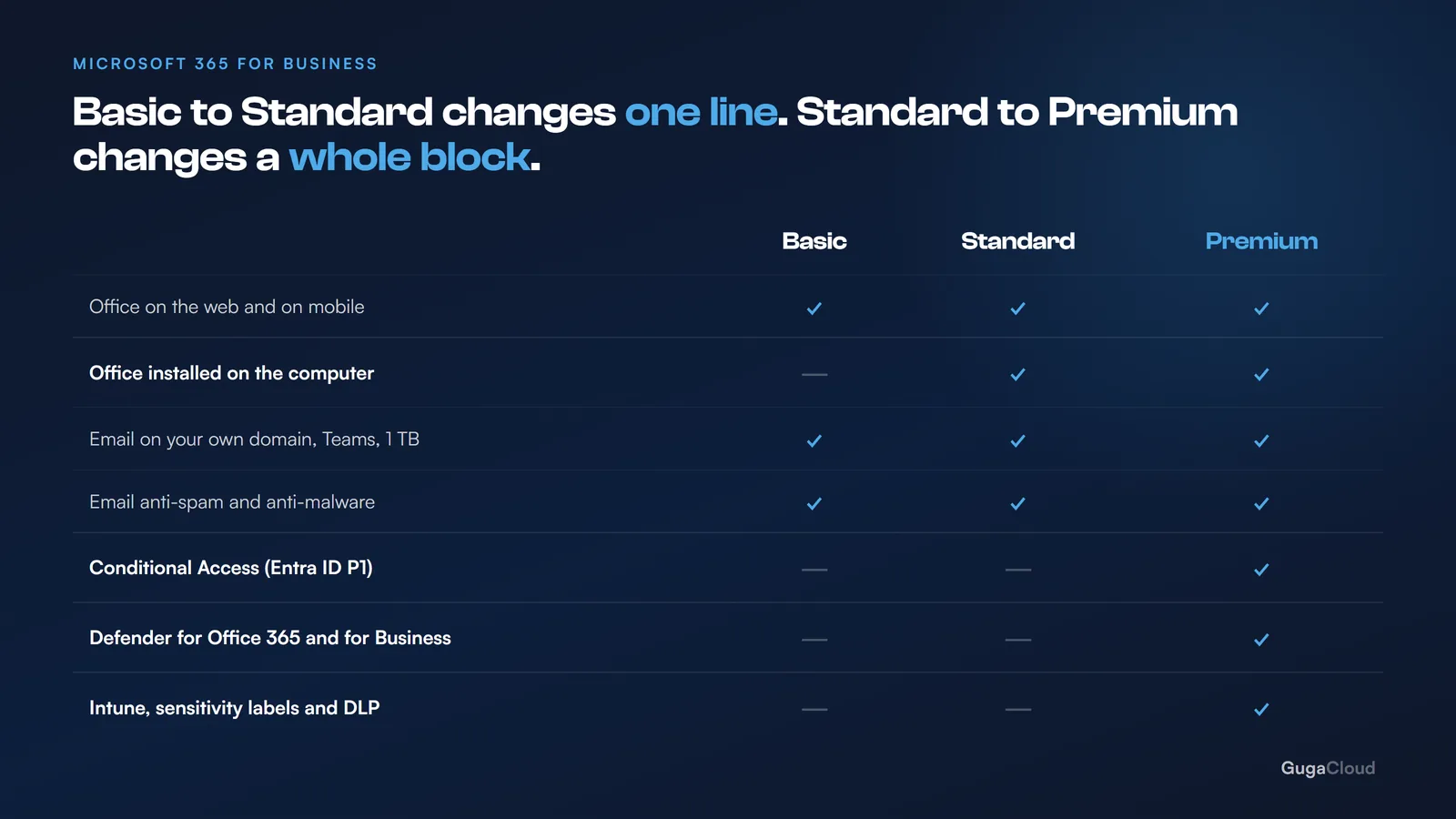
What you are actually buying
| Basic | Standard | Premium | |
|---|---|---|---|
| Office in the browser and on mobile | ✔ | ✔ | ✔ |
| Office installed on the computer | — | ✔ | ✔ |
| Email on your own domain (50 GB) | ✔ | ✔ | ✔ |
| Teams, meetings up to 300 people | ✔ | ✔ | ✔ |
| OneDrive 1 TB + SharePoint | ✔ | ✔ | ✔ |
| Email antispam and antimalware | ✔ | ✔ | ✔ |
| Identity (Microsoft Entra ID) | Free | Free | Plan 1 |
| Conditional Access | — | — | ✔ |
| Defender for Office 365 | — | — | Plan 1 |
| Defender for Business (endpoint) | — | — | ✔ |
| Device management | Basic | Basic | Intune Plan 1 |
| Sensitivity labels and DLP | — | — | ✔ |
Look at the shape of it: from Basic to Standard, one row changes. From Standard to Premium, an entire block changes — and none of those rows has anything to do with editing documents.
Microsoft publishes the plan list in the Microsoft 365 for business overview and the security comparison in the security overview. What matters is translating that into your own operation.
Basic → Standard: installed Office
This is the simpler of the two decisions, and the one that causes the most regret when it is made on autopilot.
Business Basic does not include installed Office. Word, Excel and PowerPoint run in the browser and on mobile — and that is all. It is not a configuration limit, and it is not something an administrator can switch on: it is what the license allows. Companies that buy Basic expecting to install Excel on a laptop find out on day one, and it is by far the most common complaint about the plan.
Office on the web handles far more than people expect. For someone who writes email, fills in a simple spreadsheet and joins meetings, it is enough and sometimes better — it saves on its own, and there is never a version conflict.
Where it does not hold up:
- Heavy Excel. Large pivot tables, Power Query, macros, VBA, add-ins. Excel on the web stalls where the installed version does not even blink.
- Working without internet. People who travel, visit sites, work in the field.
- Installed Outlook. Plenty of people simply do not produce well in Outlook on the web, and that is a legitimate reason.
- Documents with demanding formatting. A proposal with brand identity, a mail merge, a complex template.
- Third-party add-ins. Accounting, legal or engineering software that installs a toolbar into Office.
The test is straightforward: does this person open heavy files, work offline or depend on an add-in? Standard. Otherwise Basic does the job and costs considerably less.
And here is the point almost nobody uses to their advantage: these two plans coexist in the same tenant. Field and operations staff are often perfectly well served by Basic, while finance and sales need Standard. You are not obliged to pick one plan for the whole company.
Standard → Premium: what happens when someone makes a mistake
Here the difference is not in anything a person touches day to day. It is in everything that happens on the bad day.
Scenario 1: the phishing link
An email lands in your finance manager’s inbox with a link to a page identical to the Microsoft sign-in screen.
On Basic or Standard: the antispam filter tries to block it. If the email gets through — and new campaigns do get through, because they are not on any list yet — the link is live and clickable. That is where the protection ends.
On Premium: Defender for Office 365 Plan 1 rewrites the link. When the person clicks, Microsoft checks the destination at that moment. If the page was flagged as malicious in the preceding minutes, the click is blocked. The same applies to attachments: they are opened in an isolated environment before they reach the person.
The difference is between “we hope the filter catches it first” and “we check at the moment of the click”.
Scenario 2: the password leaked
Someone reused their corporate password on a site that was breached. Now an attacker on the other side of the world has your sales director’s password.
On Basic or Standard: you have Entra ID Free, which brings security defaults — and that is already a lot, because it means MFA is on for everyone. The attacker needs the second factor. But it is all or nothing: MFA for everybody, under the same conditions, with no nuance.
On Premium: you have Entra ID P1, and with it Conditional Access. Now you can write real rules: block sign-ins from outside the country, require MFA only when the person is off the office network, allow email access only on registered devices, prevent downloads on an unmanaged computer.
It is the difference between a door with a lock and a front desk that knows who you are, where you came from and what you are allowed to carry out.
Scenario 3: the laptop was stolen
On Basic or Standard: you change the password and hope. The synced OneDrive files are sitting on that disk. If BitLocker was not enabled — and without centralized management it usually is not — all it takes is pulling the drive.
On Premium: Intune had already enforced BitLocker as policy. The disk is an encrypted brick. And you trigger a remote wipe.
Scenario 4: ransomware
On Basic or Standard: the Windows antivirus does its job, which is a reasonable job. You find out about the problem when someone calls to say their files will not open.
On Premium: Defender for Business brings EDR — endpoint detection and response. Suspicious behavior raises an alert and the device can be isolated from the network automatically, before the encryption finishes spreading. You get a console that tells you which machine, which process, which file.
So which one is your case?
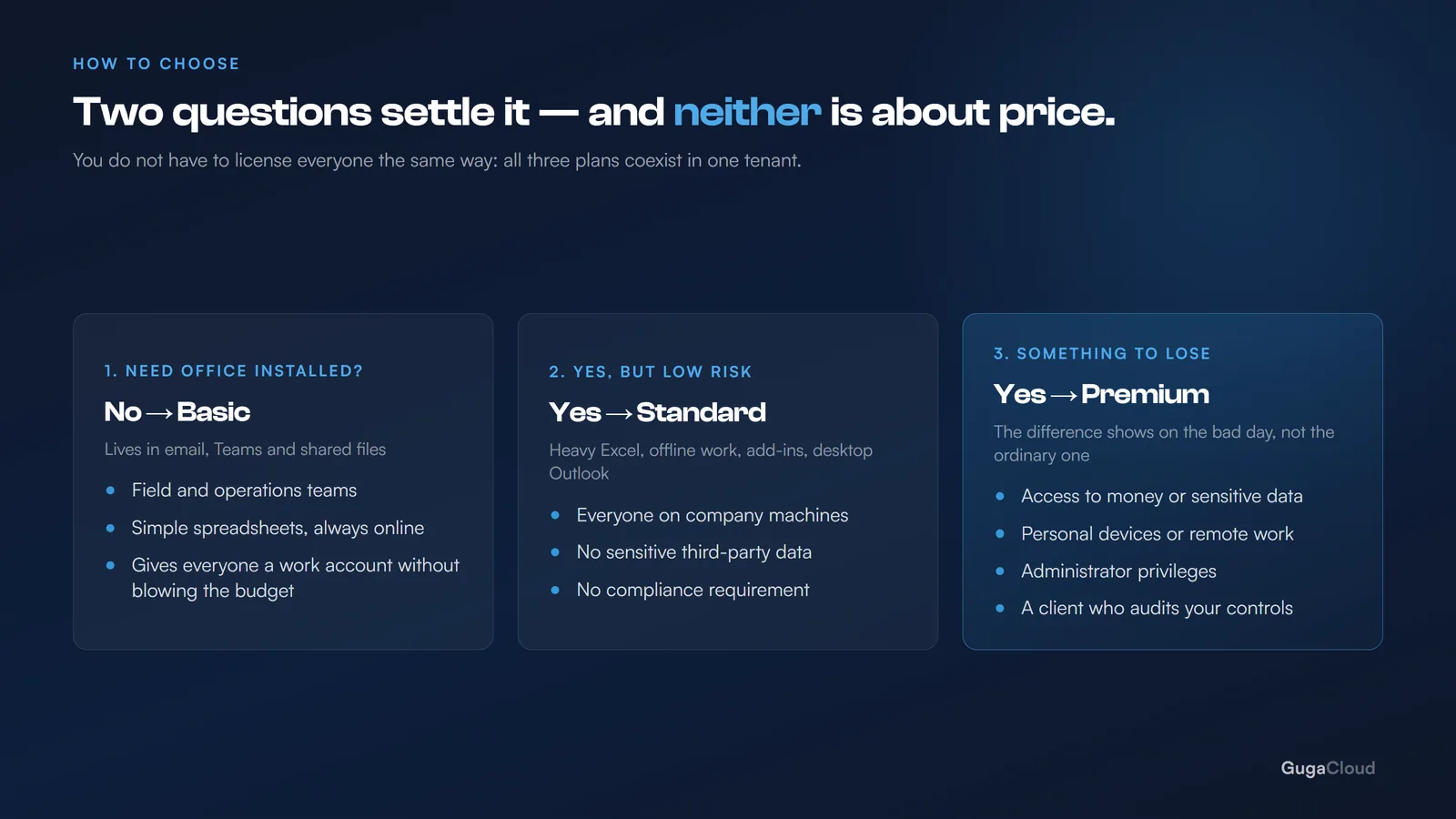
Basic is the right choice when:
- the person mainly uses email, Teams and shared files;
- the spreadsheets are simple and the work always happens online;
- it is field staff, operations, an intern, or anyone who just needs to be in the environment;
- you want to give everyone a corporate account without blowing up the cost — and that is good for security, because it stops people using personal Gmail for work.
Standard is the right choice when:
- the person depends on installed Office for the reasons in the list above;
- the operation is small, everyone works on company machines, in the same place;
- you do not hold sensitive third-party data and have no compliance requirement to meet;
- the price gap to Premium is the difference between fitting the budget and not fitting it.
Premium starts paying for itself when:
- there is remote work, or personal devices accessing company data;
- you hold client data that GDPR or your local data protection law treats as sensitive;
- someone has already clicked on something they should not have (once is enough to change the conversation);
- the person has access to money — accounts payable, transfer approvals, payroll;
- a large client is going to audit your controls before signing.
The criterion is not the size of the company. It is the size of the damage one wrong click can do.
A ten-person company that moves payments has more concentrated risk than a sixty-person company selling physical goods over a counter. The number of users is the worst possible metric for this decision.
The design almost nobody puts together
You do not have to license everyone the same way. Microsoft 365 lets you mix all three plans in the same tenant, and that is how the numbers genuinely work out.
The design we recommend most often in a 25-person company:
- Premium for anyone with access to money, to sensitive data or to administrative privilege — typically leadership, finance, HR and IT. That is usually six or seven people.
- Standard for anyone who depends on installed Office — sales, projects, in-house accounting.
- Basic for the people who live in email and Teams — field, operations, support.
Instead of 25 Premium licenses, you end up with seven. The cost drops by close to 60% and the main risk — the accounts that genuinely matter — stays covered.
The honest caveat: Conditional Access is configured per user, and some device policies apply to the machine, not to the person. If the laptop belonging to someone on Standard joins the same network, it does not inherit the Premium protections. The numbers still work out in most cases, but the design has to be thought through, not guessed at.
Three questions before you decide
Forget the price list for a minute:
-
Who in the company genuinely opens heavy files, works offline or uses an add-in inside Office? Those people need Standard. The others may not.
-
If an email that looked like it came from our supplier asked us to change their bank details, who would have the authority to do that without verifying? If that person exists, that person needs Premium.
-
How many devices access company data right now, and how many of them does IT actually control? If the two numbers do not match, you have an attack surface that neither Basic nor Standard covers.
Buying Premium for everyone is waste. Buying Basic for everyone creates friction for the people who need real tools. The right answer is almost always a mix of the three, and finding the proportion takes a half-hour conversation.