
Every company that buys Microsoft 365 ends up having this conversation: we already have Teams, so why is the team still working out of a WhatsApp group?
The honest answer is that WhatsApp genuinely wins on some things, and pretending otherwise is the fastest way to lose the argument. But it loses badly on others, and those others tend to show up only at the worst possible moment.
How dominant the messaging app is varies a lot by country — in much of Latin America, southern Europe, Africa and Asia it is simply how everybody communicates, while in other markets the same role is played by iMessage or SMS. The trade-offs below hold either way. Read “WhatsApp” as “the messaging app your team already uses” wherever that fits your market better.
Where WhatsApp genuinely wins
Adoption. Everyone already has it, already knows how to use it, already has it open. No corporate tool competes with that, and no amount of training closes the gap.
Speed. Short message, immediate reply, no ceremony. Nobody opens an app, finds a channel and composes a paragraph to say they are running late.
Reach for people who do not sit in front of a computer. Field teams, construction sites, shops, delivery drivers. For that audience, requiring them to open Teams on a phone is real friction, and friction means the message does not get read.
Anyone who dismisses those points is arguing with reality, not with WhatsApp.
Where WhatsApp gets expensive
The problems do not show up in day-to-day use. They show up when somebody leaves.
1. The history walks out with the person. The conversation lives on their personal phone. What was agreed with a customer, a pricing decision, an approved discount — all of it goes out of the door with the employee, and you have no copy of any of it.
2. The number is personal. When the salesperson leaves, the customers still have their number, and the salesperson still has the customers. In many cases the company finds out far too late that the relationship was never theirs.
3. There is no control at all. No record of who accessed what, no way to revoke access, no retention. If a customer disputes what was agreed, there is no official source to check — only screenshots, from a phone you do not own. And when the dispute turns into a legal matter, “we would have to ask a former employee for their chat history” is not an answer anybody wants to give.
4. Customer data in a personal app. Sending a national ID number, a signed contract, health information or financial data through a personal WhatsApp account is a problem under GDPR or your local data protection law, and most companies would rather not look at it too closely.
5. Files die in the group. The spreadsheet somebody sent three months ago is gone. Nobody can find it, and the version that survives is whichever copy somebody happened to download to their phone.
6. It does not switch off. A work group in a personal app means work at eleven at night. That is a real cost, in health and in staff turnover, and it is paid by the people least able to push back.
What Teams does better
The conversation stays with the company. The person leaves, the history remains.
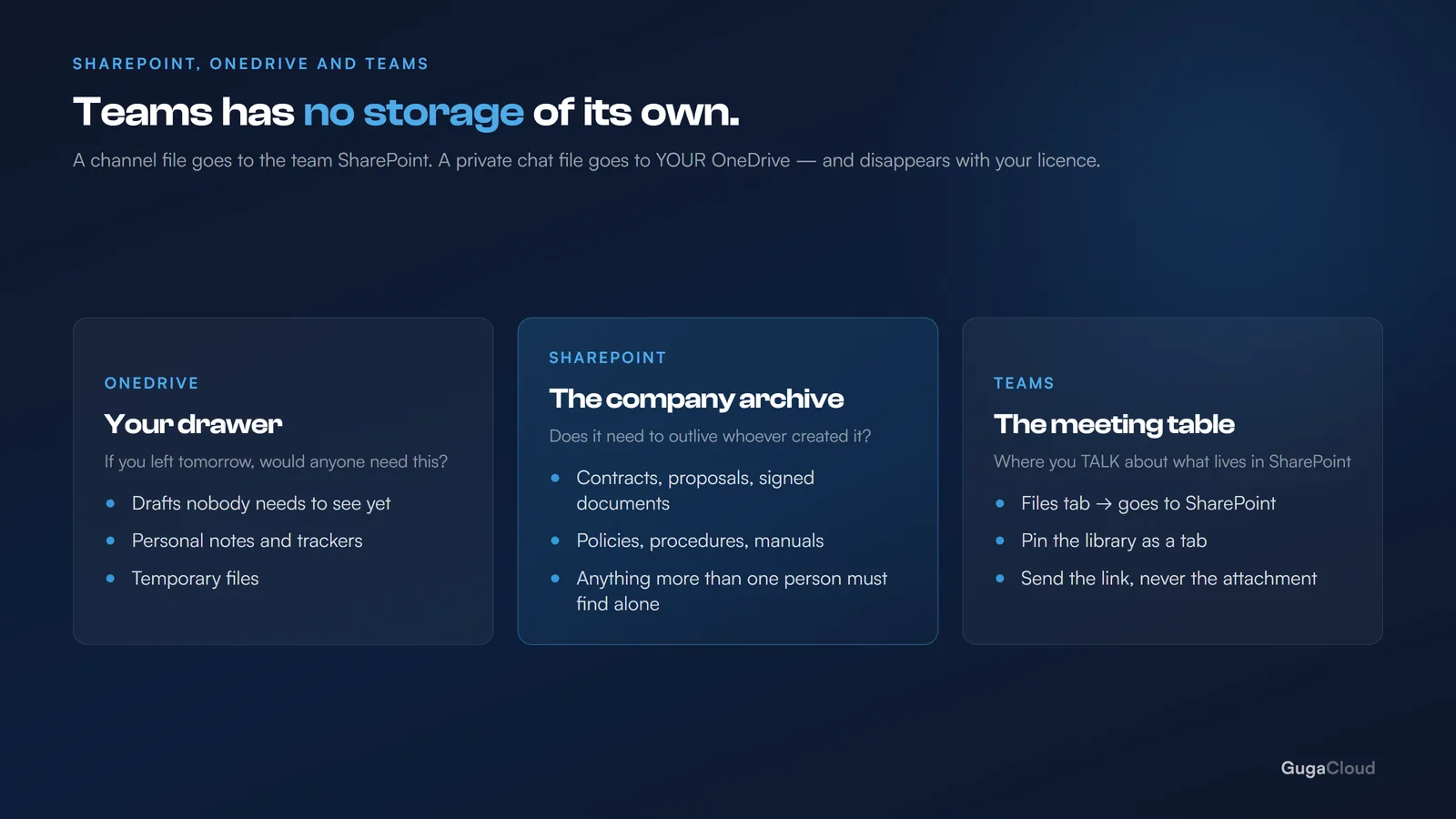
Files have an address. Anything posted to a channel lives in the team’s SharePoint site, with version history and search. The reasoning is in where each company file should live.
Search that works. Finding “that message about the Acme contract” is actually possible, months later, and it searches the files as well as the messages.
Control and compliance. Retention, audit, revoking access. Without those, there is no answer to “who authorised this?”.
Integration. Meeting, file, approval and conversation in the same place, as Microsoft documents.
It separates work from life. You can close it, and closing it does not mean missing a message from your family.
The split that works in practice
Having watched this play out in a number of companies, the arrangement that survives is not “ban WhatsApp”. Bans fail, quietly and quickly: the group goes on existing, it just stops being mentioned in meetings. What works is to split by purpose, so that each tool has an obvious job and nobody has to think about which to use:
| Tool | |
|---|---|
| Decisions, approvals, what was agreed | Teams |
| Anything involving a file | Teams |
| Project or customer matters | Teams |
| Conversation with an external customer | WhatsApp (on a company number) |
| Getting a message to the field team | |
| “I’ll be ten minutes late” | WhatsApp, and that is fine |
| Out-of-hours emergencies | WhatsApp, with agreed criteria |
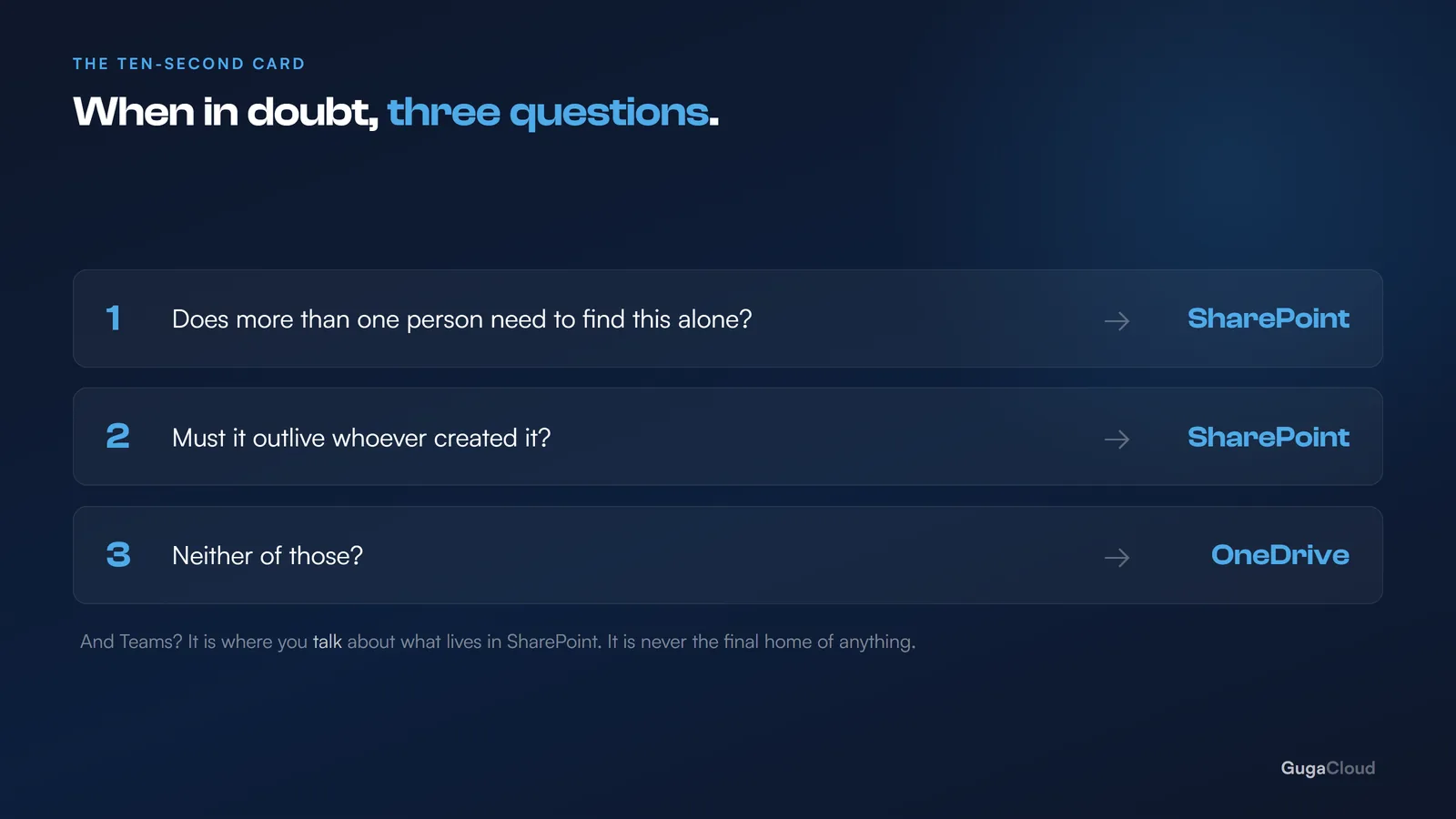
The rule in one sentence: whatever needs to still exist in six months goes in Teams. Whatever dies in six minutes can stay in WhatsApp.
The one point that fixes half the problem
If you make one change, make this one: the WhatsApp account that talks to customers has to be a company number, not the salesperson’s mobile.
With WhatsApp Business and a company-owned number:
- the history belongs to the company;
- more than one person can answer;
- when somebody leaves, the customer does not leave with them;
- conversations can be handed over.
That removes the biggest commercial risk — losing customers along with an employee — without asking anybody to change a habit. It is also the cheapest item on this list, which is why it is strange how rarely it gets done.
When Teams is NOT worth it
Worth saying, because some people force it:
- Field teams with no corporate account. If the person has no licence, pushing them into Teams is friction for nothing. Business Basic is cheap and solves it — but if even that does not fit the budget, use WhatsApp and move on.
- Customer communication that is already on WhatsApp. Do not ask your customer to install Teams. You lose the customer and you do not gain the compliance.
- A team of three people in the same room. An asynchronous collaboration tool for people who talk out loud is ceremony with no return. Put the files in SharePoint and keep talking.
- If the company is not going to agree the rule. Teams deployed without an agreement becomes one more app that is open, and then you have two disorganised channels instead of one.
What to do this week
- Check which number customer contact goes out from. If it is a personal mobile, that is both your most expensive risk and your easiest fix.
- Pick one subject to start in Teams. One project, one department. A full migration all at once does not stick.
- Write the agreement down in one sentence and put it where everybody sees it. Structure without an agreement is back on WhatsApp within four weeks.
The question that usually settles the conversation internally: if our best salesperson left tomorrow, what would the company lose along with their phone?